
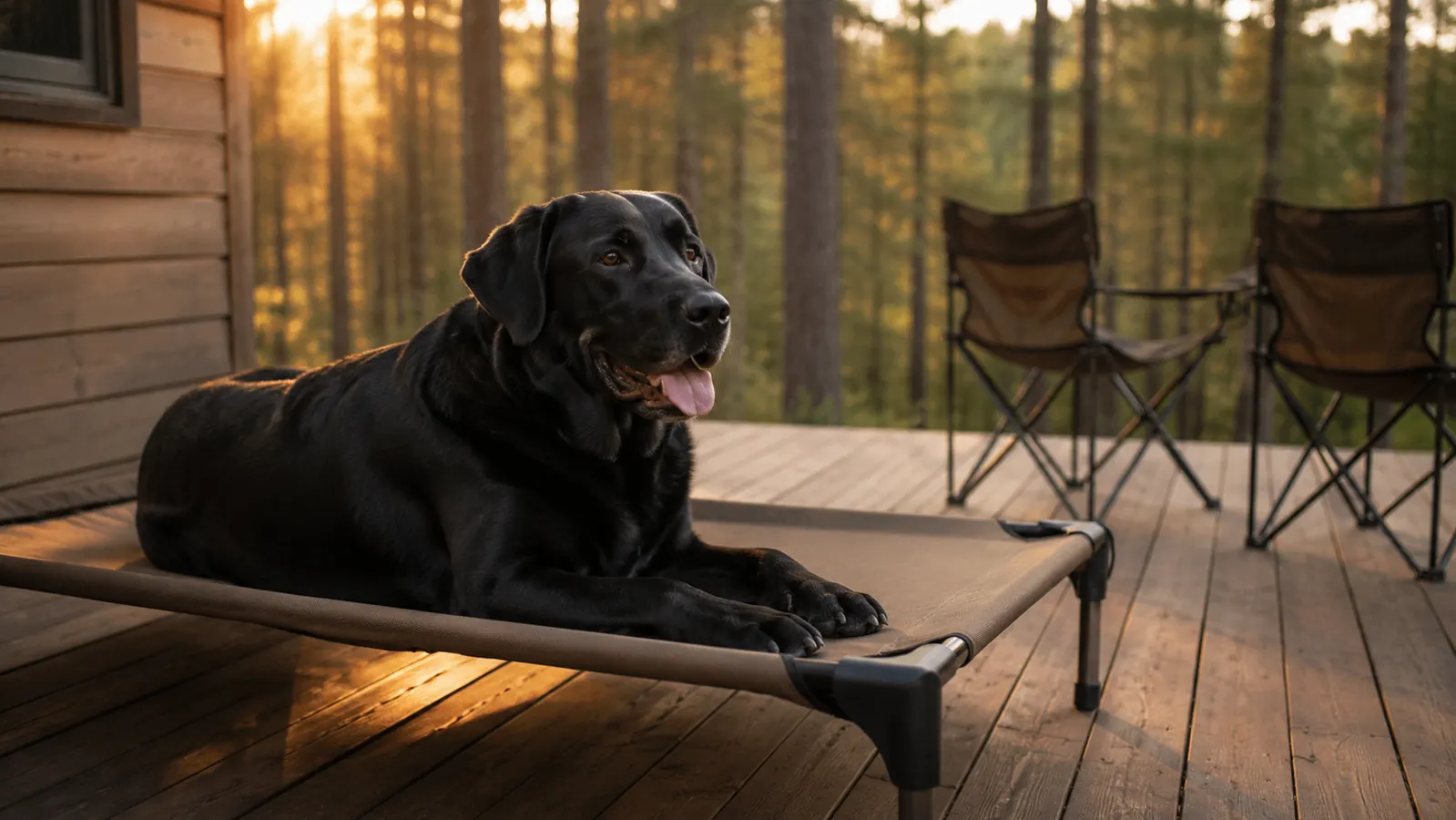
The first sign that a summer dog bed is dead is the smell. Last July I walked out onto the camp deck after a wet morning of retrieving drills and found the old puffy cushion soaked straight through, water pooled in its middle seam like a sponge that had given up, and Bo standing over it with the exact face a dog makes when its bed has betrayed it. That cushion got six weeks of real use out of us, and it was the fourth one I had bought in two years. I ordered the Coolaroo elevated bed that same week, mostly out of spite, and two summers later it is still the only dog bed on this property that has not wound up in the burn pile.
Full disclosure before the praise, because nobody in this house trusts a review with no warts. I tested this bed the way I test everything, by using it every day for two years. Bo is my 70-pound black Lab, camp dog since he was a pup, and June is a 45-pound Border Collie mix who treats every campsite like a deed in her name. Between them they have logged about 18 camp nights and every hot afternoon of two summers on this bed. I bought mine with my own money off the same product page you are looking at, and this is the honest version of that story, annoyances included.
The Quick Verdict
Two summers of daily camp and deck duty from a 70-pound Lab, and the mesh still breathes, still snaps tight to the frame, and still keeps Bo off the ticks and the damp ground. Buy the Large for any dog up to roughly 80 pounds. It is not a nesting bed and a gust can flip an empty one, but for an outdoor and camp dog it is the bed that actually stays fixed.
Amazon Check Today's Price →The Bed That Outlasted Every Cushion We Owned
Bo has slept on this mesh every summer night for two straight years. If you have buried your third soggy cushion this season, this is the fix that actually stays fixed.
Amazon Check Today's Price on Amazon →How I've Used It
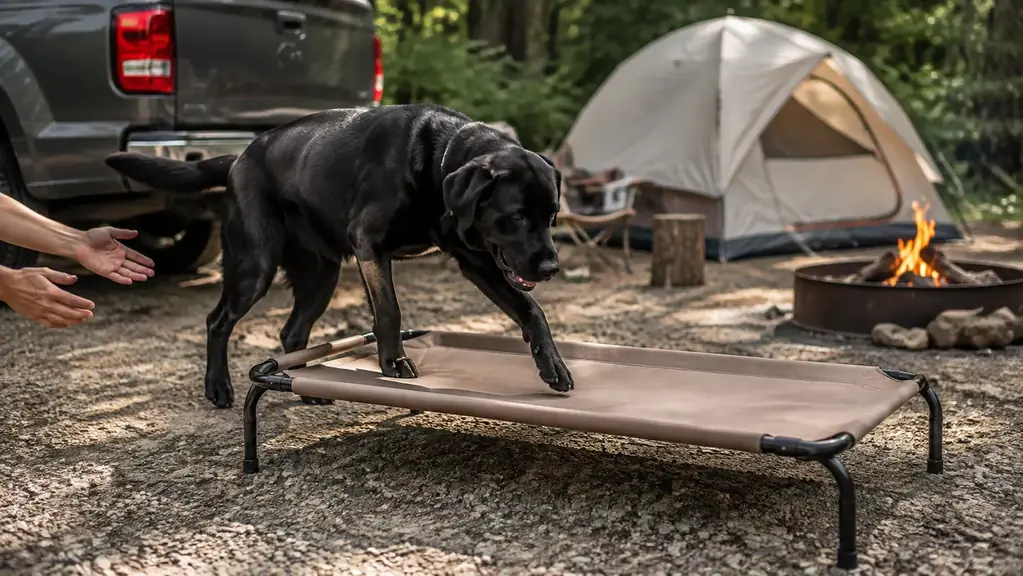
The backstory matters, because praise only means something with context. I set this bed up on the camp deck in late May of 2024, thinking it would be a weekend experiment. Since then it has survived about 18 campouts on gravel, dirt, and one windy river site; full summer deployment on the porch; a torrential rain that left it standing in a puddle overnight; and Bo launching onto it from a standing jump roughly a hundred times, which is 70 pounds dropping out of the sky. If a bed was going to fail, I gave it every excuse and then a few I did not plan on.
The routine is part of the house now. On mild afternoons the bed stays on the deck, and Bo is on it by nine in the morning like it owes him money. At camp it rides in the truck bed so he can rest off the hot gravel, then moves to the shaded spot under the awning for the afternoon nap he treats as his birthright. And because the whole thing folds flat, it travels like a camp chair instead of a piece of furniture, which matters in a truck bed that already holds two dogs and a cooler. Folding it takes about twenty seconds, and it stows flat against the side of the bed without swallowing the space the tie-outs and dog food bags need.
Assembly is easier than the box suggests. The frame arrives in two halves that lock together with a center cam, and the mesh snaps onto the rails around the edges. My first setup at dusk took maybe eight minutes, and every re-fold since has been under two. The only knack is getting the last corner snapped without the mesh fighting you, which you solve by working around from one corner instead of opposite corners at once.
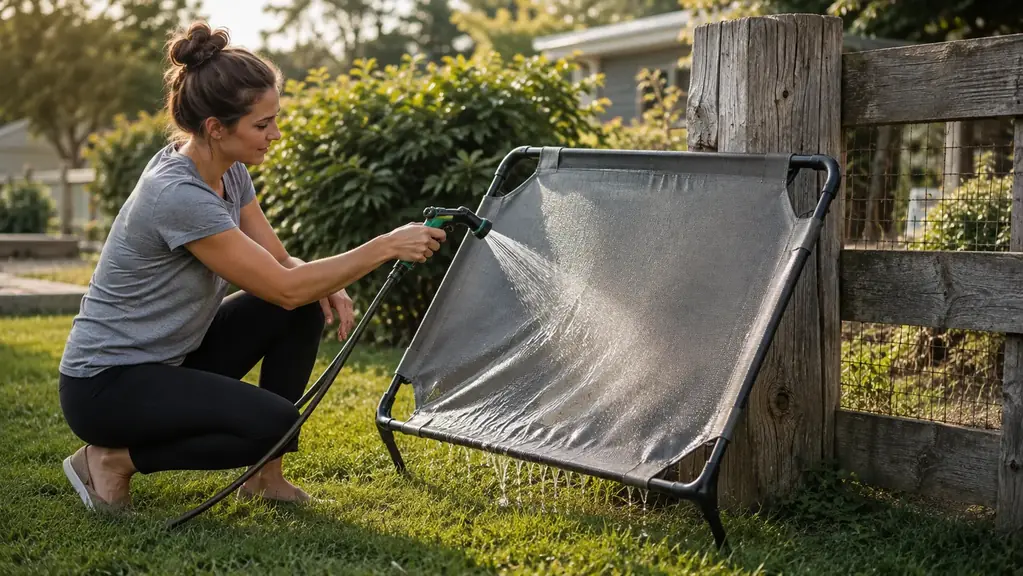
Cleaning turned out to be the surprise that sold me for good. The first time Bo came back from a pond edge caked in mud and lay straight down, I braced for the same ruined-cushion scene as always. Instead I grabbed the bed by the frame, ran the hose over it for thirty seconds, and the woven mesh let every bit of it wash straight through. It was dry enough for him to nap on again the same afternoon, with no drying rack and no week-long stain to live with. That single cleanup bought the bed more goodwill than any feature on the box.
What the Coolaroo Actually Is
Strip the marketing off it and the Coolaroo is a simple thing: woven polyethylene mesh stretched over a powder-coated steel frame that carries it about six inches off the ground. No springs, no foam, no stuffing, nothing that can mat down or soak through. It is a camp cot for a dog, and the reason that matters is airflow. A dog sheds heat through its belly, and a cushion traps that heat against the skin. Mesh does not trap anything. On a 90-degree day you can put your hand flat under Bo's belly while he sleeps and feel the air moving.
The frame carries an underside support bar, and the fabric snaps onto the rails at the corners and along the edges. Those snaps are the whole ballgame, because they keep the surface drum-tight instead of bagging into a hammock the moment a heavy dog climbs aboard. After two years and those hose washings, every snap on ours still seats with a firm click. That tension is what separates this from a cheap patio lounger with a sagging sling, and it is the first detail I would check on any elevated bed you are considering.
Sizing is where Coolaroo hands you the homework. The Large measures 42 by 30 inches and the frame is rated around 90 pounds, which I found honest for a dog that sleeps stretched out. Bo at 70 fills it nicely with room to angle his legs, and June curls into the corner like it was reserved for her. Buy for your dog's sprawled-out length, not the number on the scale. Measure your dog stretched out on the floor, add a few inches of clearance on every side, and match that to the stated dimensions. And do not overthink the color. Nutmeg blends into camp gear without shouting.
Two Summers of Durability
Here is the section the ad copy never reaches. The mesh: after two seasons there are no rips, no pulled threads at the corners, no permanent stretching. The center does relax by maybe an inch under Bo's weight and then straightens back out when he stands. That is the normal behavior of every mesh bed I have tested, including ones at three times this price, and it has not gotten worse since the first month. I checked it again two weeks ago by running a level across the surface with Bo on it, and the sag is not the kind that deepens over time.
The frame: the steel has kept its shape with zero bending, and the coating has peeled nowhere despite weeks outside at a stretch. The weld at the center crossbar is still solid. I did believe it had loosened during that windy river weekend, because the bed hummed against the deck boards with every gust, but once I angled it flat against the cabin wall the noise stopped. It had never flexed at all; it had just been leaning against a lever. The only cosmetic wear is thin rub marks on the powder coat where the dogs hop off, and that is paint, not structure.
The rain test was accidental and decisive. One July storm dumped on us overnight while the bed sat on the porch in a growing puddle. I found it floating the next morning, mesh dry on top and frame unscathed, and after a minute with the hose it was back in service. That is the moment I stopped worrying about the lifespan of this thing, because a flooded porch is the worst case I can invent, and the bed shrugged it off. Between the weather, the dirt, and Bo's launch-and-crash routine, I have tried hard to kill this bed and it has politely declined.
The same mesh that kept Bo off a 95-degree gravel bed in July has taken ten hose washings and still snaps tight to the frame.
The Honest Tradeoffs
No product gets a free pass here, so here is what the Coolaroo is not. It is not a nesting bed. June's Border Collie wiring makes her circle and scratch at it sometimes, and there is nothing to burrow into, so she settles for flopping across it. A dog that needs to dig a nest will not fall in love with stretched mesh, and I would not pretend otherwise. If your dog is a burrower who shoves cushions into a pile before lying down, buy a covered crate instead and save yourself the disappointment.
The wind thing is real, and I keep mentioning it because the reviews bury it. An empty bed on an open deck will catch a gust and flip, and I have come home to ours tipped on its side more than once. My habit is to lean it against the wall on windy days until a dog plants it again. That tradeoff is worth naming twice, because plenty of buyers only find out after the first big storm, and by then they are already annoyed. And because it is built to stay cool, it runs breezy in the shoulder seasons, so a dog sleeping outside in a 40-degree night wants a blanket, a covered corner, or a different setup entirely.
The chew question deserves a straight answer. The mesh is tough, and a taut durable weave resists a lot, but it is not armor. A dedicated fabric chewer has the leverage to worry at a corner, and a single pulled thread can snowball fast. I do not leave it out when the dogs are in a destructive mood, though full credit to Bo, he has never once chewed it in two years. A dog that eats cushions whole is a different conversation entirely, and for that dog this is not the first bed I would hand them.
Alternatives I Considered
The two elevated beds I get asked about most are this one and the K&H, and my opinion is earned because I have slept dogs on both. The short version of that full comparison: the Coolaroo wins on price, packing weight, and how little it stings to replace, while the K&H carries a stiffer frame that some heavier dogs prefer and costs noticeably more. For the way I use a bed, the Coolaroo is the one that stayed in my rotation. If your dog pushes past the weight rating where the mesh starts to bag, that single scenario is where I would point you at the K&H instead.
I also dragged an orthopedic-style foam bed out for one wet week, fully expecting it to win me back. It failed in about eleven hours: it soaked through a single rainy afternoon, needed the truck to get anywhere, and after a month on the grass it was doing its best impersonation of a tick staging ground. The foam bed has a place on the living room carpet. Outside, at camp, it has absolutely none. That experiment settled the outdoor question for good.
I tried a cheap generic mesh cot too, the kind you find for a third of the price at a big box store. It held up for roughly one season before the sling sagged into a bowl and the plastic feet cracked on the gravel. It was not worth saving, and it is why I stopped recommending budget elevated beds on price alone. The Coolaroo is not the cheapest elevated bed you can buy, and there is a real reason, the frame holds its tension and the mesh stays tight.
If your dog lives inside on carpet ten months a year and you only need one bed that survives weekend camping, the elevated mesh is the buy. If you want the size math and the wash routine spelled out in one place, my full checklist for choosing an outdoor bed covers the whole process. And if you are stuck between this and the K&H, the head to head comparison walks through the weld points, the fabric, and the honest weight limits of both.
What I Liked
- Woven mesh breathes, so a sleeping dog sheds heat instead of baking against foam
- Keeps the dog six inches off ticks, fleas, moisture, and mud at camp
- Survived two full summers for me, and hose-washes clean in under a minute
- Folds flat and rides in the truck bed like a camp chair
- No foam or stuffing to compress, so it never flattens out the way cushions do
Where It Falls Short
- Center mesh sags about an inch under a heavy dog, normal but real
- Empty bed can tip over in a wind gust on an open deck
- Not a nesting bed; burrower dogs may not take to it
- Powder coat wears at paw spots after two seasons, a cheap paint touch-up
- Runs cold in shoulder seasons for an outdoor-sleeping dog
Who This Is For
Buy the Coolaroo if your dog spends any real part of its week outdoors, in the truck, or at camp. It is the right bed for the deck supervisor, the retriever that comes home coated in pond water, and the camp dog that decides a patch of gravel is prime napping real estate. It is cheap insurance against a summer spent panting on a hot surface, and against the vet bill for ticks that a ground-lying dog collects by August. If you camp at all with a dog, this is one of the first pieces of gear on my list, right up there with the shade and the water.
It is also the bed for the owner who is tired of replacing cushions. With a dog that actually uses one, I burn through three or four cushioned beds a year. This one has been a single purchase across two years, and the only reason I would buy a second today is so I can leave one in the truck bed and stop lifting this one back and forth. That savings is easy to forget until you total up what the previous summer actually cost.
Who Should Skip It
Skip it if your dog needs a den to feel safe, or chews fabric for a living, or sleeps indoors on carpet where an elevated bed solves a problem you do not have. A nervous dog that wants walls around it is not going to settle on an open cot, no matter how much the mesh breathes. And respect the size math: a dog pushing past the frame's weight rating will turn the bed into a sling, so buy for sprawl and do not guess your way past the listed limit.
Skip it too if you need one bed for the whole year and the coldest months are the ones that matter, because this is a cooling bed by design and it will not compete with a warm covered den in January. For everyone else, this is the rare outdoor pet product that does exactly what it claims and nothing it does not, with two summers of proof behind it. I would buy it again tomorrow, and I am not easy to sell dog gear to twice.
Two Summers. Zero Flattening. That Is the Review.
If you are on your third soggy cushion this season, do what I finally did and get the bed that stayed. Amazon prices move month to month, so check what the Large is running today before you order.
Amazon Check Today's Price on Amazon →