
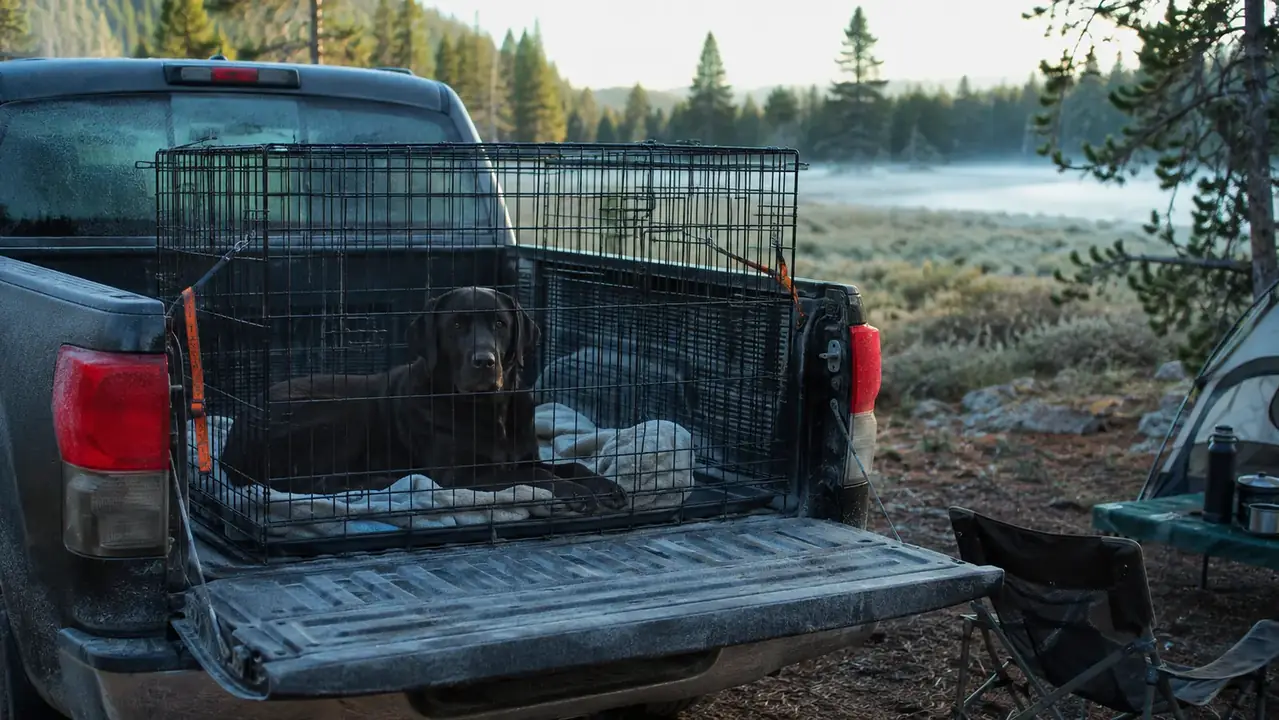
Eighteen months ago I got tired of hauling a hard plastic kennel that swallowed a third of the truck bed. The 42-inch MidWest iCrate has lived back there ever since, through two deer seasons, a summer of weekends at the fishing camp, and more muddy-dog campouts than I care to count. My 84-pound black Lab Duke rides in it on every trip, and my younger chocolate-lab cross Biscuit takes the spot when he comes along. I bought it in late January of 2025, after the plastic kennel finally did me in: it would not fold flat, it trapped heat, and every season it ate up room I needed for gear. Consider this the story of the crate that replaced it, and what 18 months of real use did to both of us.
A wire crate was a compromise I put off for years because I assumed a serious dog would warp the frame, pop a latch, or hook a paw through the bars. I have since spent 18 months proving that assumption wrong. Duke gets road-tired and wet, he launches himself through the door after a two-hour drive with a full tank of energy, and he has shoved, pawed, and flopped against this crate more times than I can count. The frame has won every argument so far. That is the short version of why this review exists at all: not a weekend test, but the crate that has carried a wet bird dog down gravel roads at first light for a year and a half, and the honest version of what held up and what did not.
The Quick Verdict
If you haul a large dog in a truck and camp with a dirty, tired animal, this is the crate to start with. The frame, tray, and fold mechanics have held up through 18 months of abuse. You pay for it in the single door, a tray that slides a little under a shifting dog, and a first assembly that wants patience.
Amazon Check Today's Price →The 42-Inch MidWest iCrate at Today's Price
Duke has now ridden hundreds of miles in this exact crate, and it still folds, still latches, and still hoses clean. If your dog runs in the 71 to 90 pound range and your trips look anything like mine, this is the foldable crate to price first.
Amazon Check Today's Price on Amazon →How I've Used It
This crate works one of four jobs on any given day, and it rotates through them continuously. Job one is the truck. Duke rides in it on every run to a hunting spot, camp, or fishing hole. I set the crate in the bed with the door facing the tailgate, run two ratchet straps over the top frame corners, and cross them to the tie-down anchors. On two-track roads and washboard it sits rock solid, which is more than I can say for any kennel loosely bungeed in place.
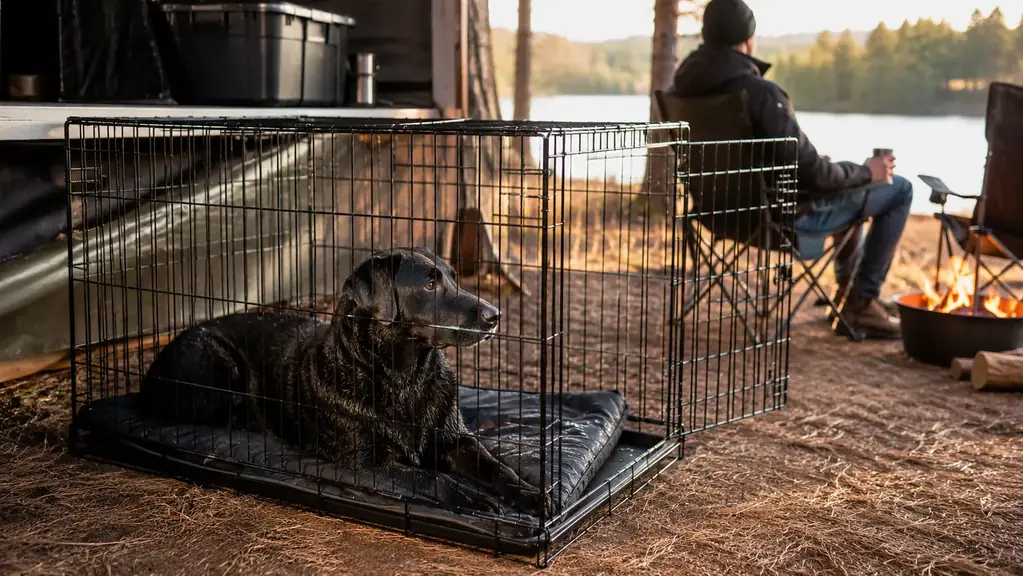
Job two is camp. The crate comes out of the truck and sits under the awning with the door open, and Duke settles in it the way a dog settles in a familiar spot. At night the door latches and he sleeps in there with the top bars covered against frost, and he stays dry through those 2am summer storms because the tray and the frame sit up off the ground. The wire means he can see out on every side, and that, more than anything, is what settles him.
Job three is the house. When a wet dog comes in from the field, the crate is where Duke airs out on cold mornings instead of dripping on every chair and sofa in the place. Job four is storage, which is the one a plastic kennel cannot do. The iCrate folds flat in about ten seconds and stands against the wall behind my shop door, out of the way, until the next trip needs it. That fold is the entire reason wire beat plastic for me.
The Frame: Where 18 Months of Dirt Show Up
The frame is welded steel tube with a black epoxy finish, and it is the part I worried about least going in and the part that has impressed me most. Two deer seasons of wet dogs, icy gravel, and creek mud have not bent a corner or cracked a weld. The finish is a separate story, and I will tell it honestly: it has chipped along the door edges where the latch rubs, and where the coating came off, the bare metal has thrown up light surface rust. Nothing that affects function now, everything that shows if you lean in close. I touch the spots up with a paint pen once a year and call that maintenance.
The fold hinge is the part to watch on any wire crate because it is the part that fails on the cheap ones. On this one the two sections lock flat with the door latched through the side, and the whole mechanism is still smooth after 18 months. I fold it in the truck bed, wet, muddy, or frozen, and it has never jammed or fought me. That was not a test I planned for, and it is the one that would have embarrassed a cheaper crate by now.
The door hardware has held up too. The push-button latch still snaps shut clean after months of Duke hooking it open with his nose at rest stops, and the hinge pins have never walked out. The one fair warning: the latch button is plastic, and if you stomp it with a boot while the crate is folded, you can crack it. I came within a boot lace of learning that the hard way on a cold morning, and now the rule is simple: boots stay off the crate.
Two deer seasons in, a wet 84-pound Lab has not bent the frame, popped a latch, or jammed the fold. The chipped powder coat along the door edge is the only scar the crate has to show.
The Catch Tray and What a Wet Lab Leaves Behind
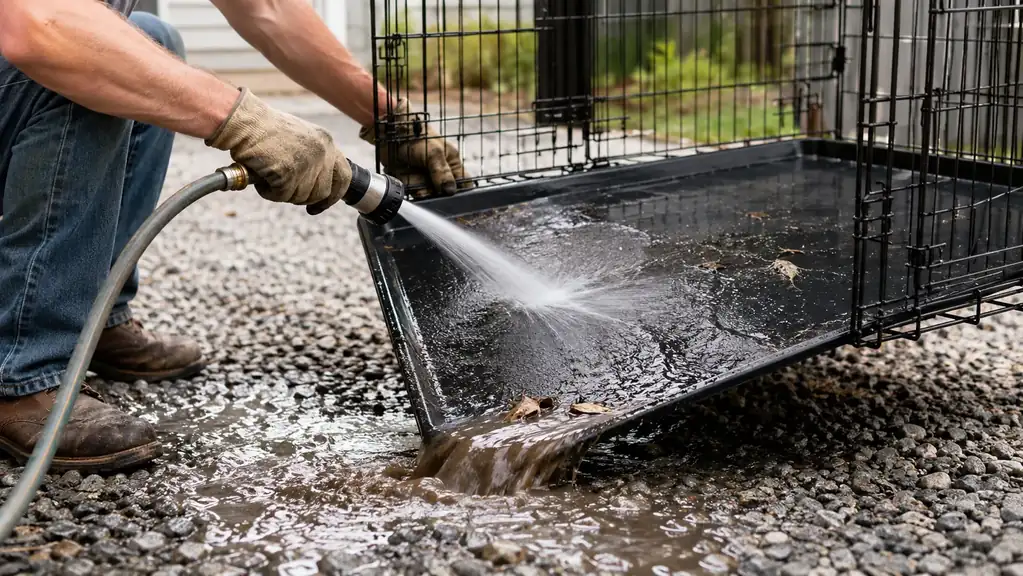
The plastic catch tray is the unsung part of this crate and the reason it has survived my dogs. Duke brings in mud, loose hair, and the general freight of a long drive in quantities that used to collect in the old kennel and never come out. The iCrate tray slides out the front, rinses clean with a hose in under a minute, and dries in the sun. Two winters of frozen ground have not cracked or warped it, and nothing about the plastic has absorbed a smell that a good rinse did not fix.
The honest knock on the tray is that it is not locked into the frame. It rests on two rails, and when Duke shifts his weight while the crate sits at an angle in the truck, the tray can slide an inch or two forward. It has never slid all the way out, and it has never dumped the old waterproof blanket I keep on top of it, but it will scoot. I run a bungee across the front door opening now out of habit, and that holds it dead still.
The Single Door: The Tradeoff You Need to Know
The 42-inch iCrate at this price tier is a single-door model, and that is the main thing I would check before you buy. With the door facing the tailgate, loading Duke means steering him around the side of the bed, and a wet, ready-to-go hunting dog is not always a cooperative pedestrian. It is a ten-second chore rather than a real problem, but if your truck layout puts the crate up against a wheel well, you will find yourself climbing into the bed to load half the time.
MidWest sells a double-door version of the same crate for a bit more money, and if I were buying today I would spend the difference. The second door on the handler side kills the loading chore completely and makes it possible to wrangle a dog from the ground instead of over the tailgate. The single door does keep the price down and gives a curious dog one fewer latch to fiddle with, which is a small, real advantage on a long trip.
One more thing I want to say flatly, because nobody budgets for it: a folding wire crate is not a crash-tested kennel. It is an excellent transport and crate-training cage, and it will not survive a real collision the way a padded, hard-sided, certified kennel is designed to. If your trips are paved and local, do not lose sleep. If you haul a dog on highways every week, budget for the hard side too.
On the Road: Rattles, Wind, and the Wire Question
Put a crate in an open truck bed and it will tell you everything about the road. The iCrate is quiet on pavement and honest on washboard: the tray skitters now and then over hard bumps, and the door makes a small rattle where the latch pin sits. I fixed both in three minutes with a bungee over the tray and a wrap of fabric tape on the pin. A quiet crate is a calm dog, and a calm dog is the whole point.
Wind noise was a surprise win. On the interstate at 70, the wire crate is quieter for the dogs than the plastic kennel ever was, because air passes through the mesh instead of drumming on a shell. Duke has gone from a dog that paced and drooled in the old box to one that curls up and sleeps by the end of the first hour, and I credit the sightlines. He can see out, he can see us, and he stops trying to figure out where the world went.
The honest warning about wire in a truck is direct sun. The wire stays cooler than a slab of plastic, but there is no roof between a parked dog and the afternoon sun, and a black-frame crate in full July light will not thank you for it. I park nose-in with the bed in shade, or I drop the tailgate and lay a blanket over the top bars at camp. Same rule you would apply to any dog standing in an open bed all day.
What I Liked
- Folds flat in seconds and stands up out of the way, the entire reason it beats a plastic kennel in a truck
- Welded steel frame, hinge pins, and latch have taken 18 months of wet, muddy abuse without failing
- Catch tray slides out and hoses clean with no absorbed smells
- Wire sides mean airflow, a quieter ride, and a dog that settles instead of paces
- 4.7 stars across more than 111,000 reviews, and in my experience the rating matches the product
Where It Falls Short
- Single door at this price makes loading from a truck bed awkward
- Tray slides an inch or two when a dog shifts weight in the truck
- Powder coat chips along the door edges and throws light rust where it chips
- Not crash-rated; a real collision is beyond what any folding wire crate promises
- First assembly wants an extra pair of hands and more patience than the box implies
Who This Is For
Buy this crate if you haul a dog in the 71 to 90 pound range in a truck or SUV, if you camp or hunt with a wet, muddy, road-weary dog that needs to dry out and settle, or if you fold your gear away between trips and cannot spare a corner of the house for a permanent kennel. It is also a very good first crate for training, because the fast fold means you are not living around a cage once the dog is done with it. If you are still working on the training side, my step-by-step crate plan for truck and camp dogs starts with the size math and pairs well with this crate.
Who Should Skip It
Skip the 42-inch if your dog runs over about 90 pounds, because that dog needs the next size up and the same money buys you the right one instead of a squeeze. Skip it if your dog destroys crates: wire chewing, bar biting, and compulsive pawing at the door are signs you need a heavier animal than any folding crate, and I say that as someone who has helped friends weld their way out of crate wars. And if you need certified crash protection, that is a padded hard-sided kennel with real test results behind it, a different purchase entirely.
That is the honest ledger after 18 months. The MidWest iCrate is not a perfect crate and I would not insult you by pretending otherwise: the single door is a chore in a truck bed, the tray slides, and the finish chips where it works hardest. What it is, is the most reliable folding crate I have owned, the one that has done every job I handed it without a single failure where it mattered. For hauling a hunting dog to the woods and back again, that is the quality I actually care about.
The 42-Inch iCrate, Priced for Today
Duke has now ridden hundreds of miles in this crate, and it still folds, still latches, and still hoses clean. If your dog lives in the back of a truck the way mine does, check today's price on the 42-inch. And if you are still weighing wire against a hard shell, my iCrate versus Petmate Sky Kennel comparison covers the other side of that argument.
Amazon Check Today's Price on Amazon →