
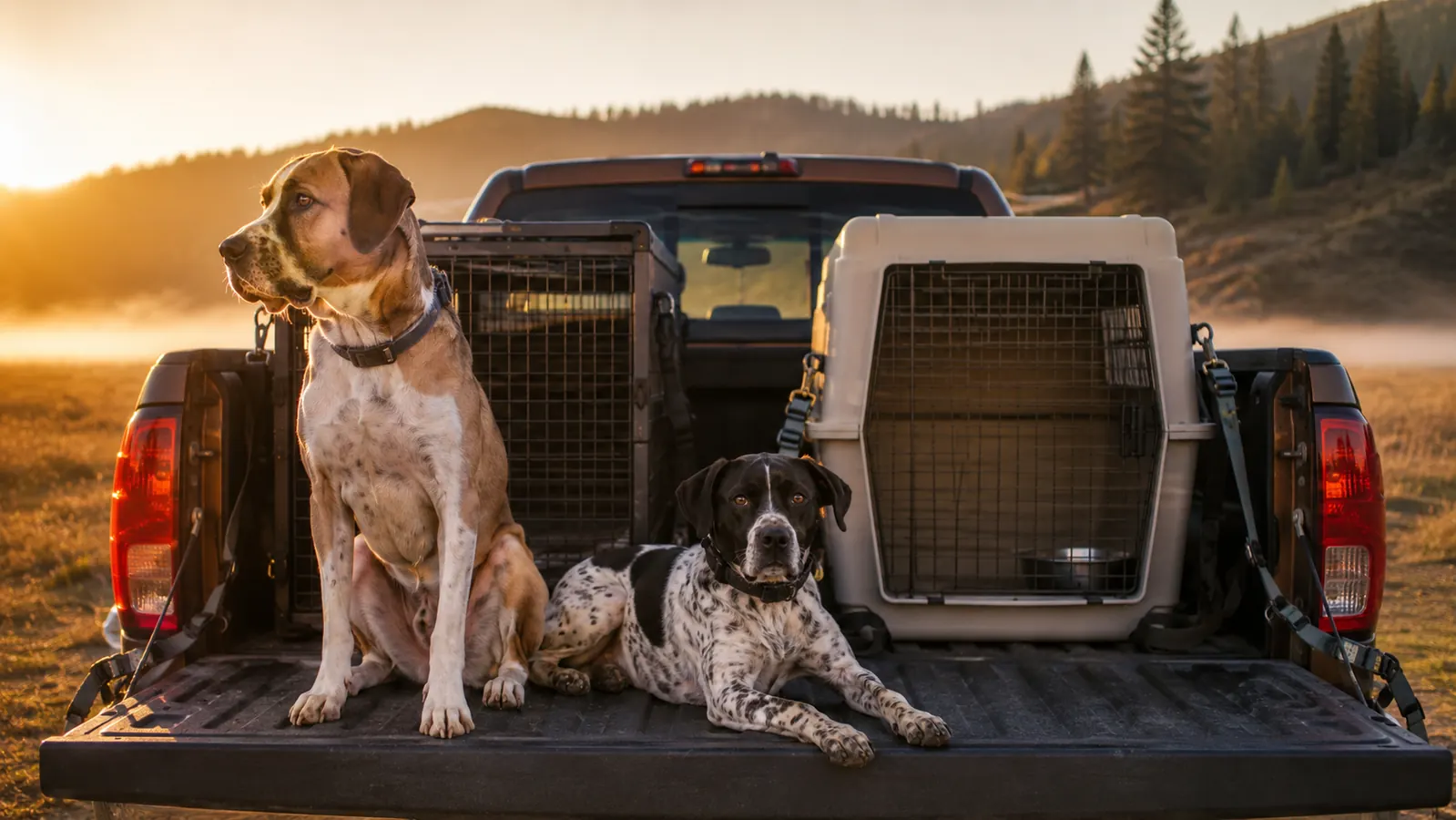
Wire or plastic. If you have hauled a dog in the back of a pickup for more than one season, that is the whole question, and everyone at camp has an answer. The guy with the hard kennel swears his pointer chewed out of a wire crate in a single afternoon. The neighbor who fishes every weekend says the plastic shell cooked his truck bed into a sauna by nine in the morning, so he gave the thing away. Here is the part nobody tells you at the campfire. Both of them are right.
So I spent a full season running both in my truck. A MidWest 42-inch iCrate on the driver's side and a Petmate Sky Kennel sized for the same two dogs on the other. Bo is my hunting dog, a 58-pound shorthair pointer who hunts tight and sleeps nervous. Nell is the camp dog, a 70-pound lab mix with a black coat that soaks up heat. Together they have ridden through cold morning hunts, a solid week of rain at one campsite, and a 90-degree afternoon on a gravel bar. By the end I knew which crate earned the permanent spot in the bed, and I will walk you through that decision, because you are almost certainly not going to buy both.
| Midwest iCrate | Petmate Sky Kennel | |
|---|---|---|
| Price | Usually the cheaper buy, often by a real margin | Costs more for a shell of the same footprint |
| Airflow | Open wire on all four sides, dogs shed heat fast | Small side vents only, holds heat in the sun |
| Rain, wind, and sun | None built in, you rig a cover or a tarp | Plastic shell blocks wind, rain, and direct sun |
| Chew and escape resistance | Bars give a chewer wire to bend and a climber bars to grip | Smooth solid walls, no grip, far harder to get out of |
| Cleaning | Hose it out, drains, dries in minutes | Scratches easily, holds scent, floor pan needs a scrub |
| Folding and storage | Folds flat in seconds, slides behind the seat | Two nesting halves but still a bulky slab to store |
| Crash behavior | Light frame, not crash rated, must be strapped down | Still no crash rating but the rigid shell keeps its shape |
| Truck-bed fit | Low flat footprint, gear stacks and straps easily | Square walls waste the corners of the bed |
| Best use | Camp, daily hunts, hot weather | Airline travel, motels, anxious chewers |
That table is the honest summary, but the reasons behind it are what decide your purchase. Read the two sections below with your own dog and your own weather in mind, because the right answer changes depending on which end of the thermometer you live on. Here is how each crate lived through the season I put it through.
How I Field-Tested Them
I kept both crates in the bed across the whole season, strapped to the same tie-downs, so neither dog got used to a favorite. My truck is a half-ton with a six-and-a-half-foot bed, so both sat side by side with the tailgate closed, which is how most of us actually haul dogs. That matters, because a long-bed truck changes the whole math, and you should check your own dimensions before you trust any crate size chart.
The goal was not to find out which crate is 'better,' because they are not competing on the same track. It was to find out which one fit each job: hot days, cold nights, rain, mud, long drives, overnight at camp, and the two-deer-season hauling that a hunting dog's back takes regular. I let Nell and Bo swap crates every other week so neither dog developed a preference I would misread as a product difference.
A couple of ground rules so this stays a fair fight. Both crates sat under the same open sky, no covers, because a cover changes the answer for both. And I did not call a winner until the season turned, because a crate that looks great in July can feel very different in January.
Where the MidWest iCrate Wins
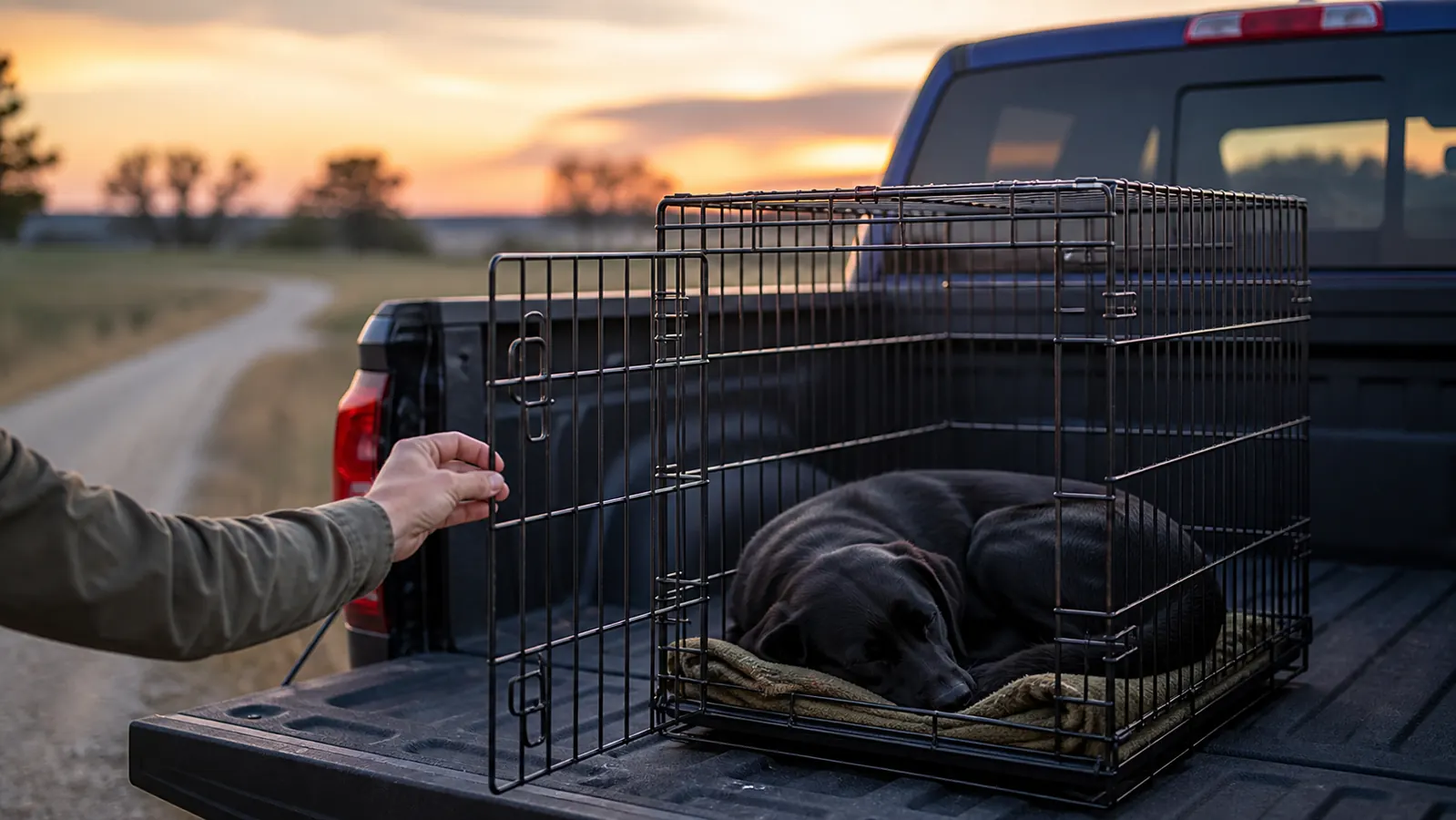
Airflow, and it is not close. A wire crate is open on all four sides, so when the truck is rolling or the wind is up, the dog gets air from every direction at once. Nell runs hot. Black coat, thick head, and zero patience for stuffy air. On that gravel-bar afternoon she laid out flat and panted with a real breeze moving through the bars while a buddy's dog baked inside a plastic kennel and tried to dig at the vents. In summer heat a wire crate wins every single time, and that is where the MidWest design does its best work.
The second win is how fast a wire crate goes from filthy to done. A dog that comes off a duck hunt is a walking mud brick, layered in stickers and creek water. I wash the iCrate with the same nozzle I use on the bed, the pan drains, and it is dry by the time I finish my sandwich. The plastic shell needs a scrub brush, scratches the first time you touch it with grit on it, and holds the smell of damp dog for a week no matter how you clean it.
Then there is folding. When the season is over, the MidWest folds flat in about ten seconds and slides behind the truck seat, out of the weather and out of the way. The hard kennel is a bulky slab that lives in the shop all summer. Fold-and-stow and hose-and-done are the two chores you face on every single trip, and the wire crate is better at both.
One more MidWest detail worth knowing before you buy. The iCrate ships with a divider panel that shrinks the interior to whatever size fits a growing pup, so you buy one crate as a puppy and never buy another as the dog fills out. Bo came to us as a pup and rode in this same box locked to the small end before he was big enough to roam. A crate that grows with the dog is a crate you only ever buy once, and that is a real point in the wire crate's column.
Same two dogs, same truck bed. Nell panted happy through a 90-degree afternoon in the wire crate, and Bo slept through a night of wind in the plastic shell. The weather decides, and it decides different.
Where the Petmate Sky Kennel Wins
Weather, and a dog that needs a den. The plastic shell is a windbreak, a rain guard, and a piece of shade, all built in. Bo is a tight, nervous dog who hates wind at night. In the kennel he settles and sleeps through weather that had him pacing the wire crate. In a hard rain I face the kennel door away from the storm and the dog stays dry with zero tarps and zero rigging. The wire crate always needed a cover, and covers flap, blow off, and trap more heat than they block.
The other big win is containment. A wire crate hands a determined climber bars to grip and a strong chewer wire to bend. The kennel is smooth, solid plastic on every wall. No handhold, no straining seam, no wire to work at. If your dog has ever popped a crate door or chewed through a strap, this shell is the one that holds them. It is also the standard shape for airline travel and motel rooms, where a dog needs to be quiet and contained, not just secure in a truck bed.
One more find, and it is a real one. The Sky Kennel opens from the top as well as the front, and that matters the night a 70-pound dog is too tired to stage through a single front door. Nell walks straight in through the top hatch and drops onto the pad. The single-door iCrate means a tired, wet dog has to back in or be lifted, and I have lifted Nell out of that truck bed more times than I care to count.
A Note on Crash Safety
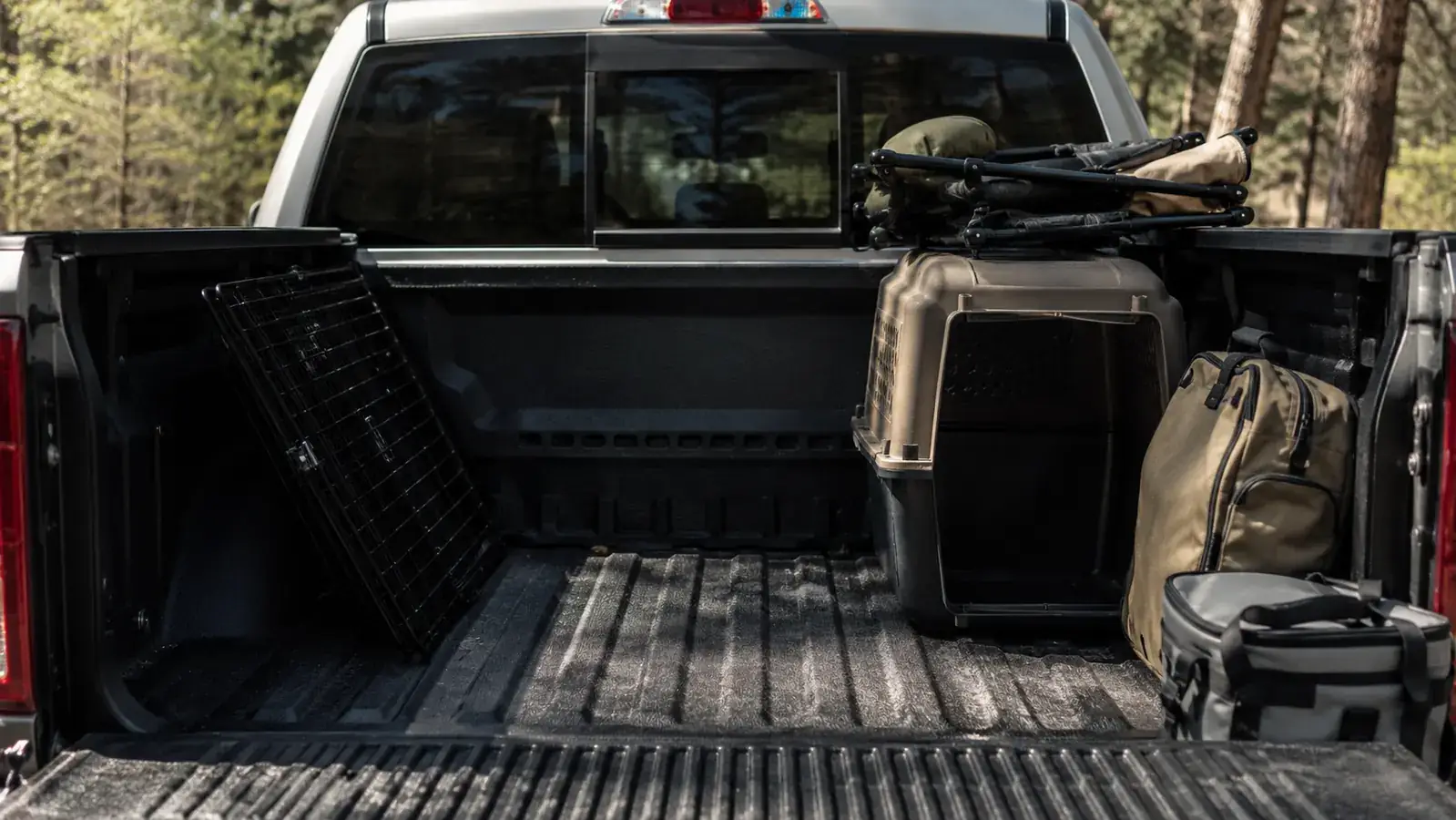
I will say the honest thing here, because too many crate comparisons skip it. Neither the MidWest iCrate nor a standard Petmate Sky Kennel is a certified crash-rated crate. They are secure and they tie down fine, but if you want genuine rollover protection you are looking at a different price class and a much heavier box. I ratchet both of mine through the bed loops, always, because an unsecured crate in a hard stop is the most dangerous object in the truck, for the dog and for the people up front.
The difference between them, for what it is worth, is that the rigid plastic shell holds its shape better than thin wire in a bend. I am not going to tell you the Sky Kennel is safe in a wreck, because it is not built or tested for that. But if you are forced to choose between the two for a crash you cannot see coming, the heavier stiff-walled box is the less bad answer. Treat both of them as storage and transport, not as armor.
What 111,904 Ratings Actually Tell You
The MidWest iCrate carries 111,904 ratings and a 4.7 average, and that number is real. It is one of the most-tested dog crates in the country, and that giant sample makes the complaints visible in the tail. People knock the plastic catch pans for cracking in cold weather. Some dogs pop the single front door. A handful of owners bend a bar on a determined chewer. None of that changes the average, because for the huge middle of owners the crate just works.
The Sky Kennel, for contrast, has a much smaller review count and a slightly lower average, and the complaints are a mirror image. The shell scratches, the latches wear, the two halves separate if you drop it loaded. What both review tails tell you is that nobody makes a perfect dog crate, and the differences that matter to you come down to dog temperament and your weather, which is exactly what this season of testing sorted out for me.
If Your Dog Runs Hot, the MidWest Is the Crate That Stuck
After a full season in my truck bed, the MidWest 42-inch is the crate I reach for on every warm trip. Open airflow on all four sides, folds flat in ten seconds, and 111,904 ratings behind it. If that sounds like your dog and your summer, check today's price on Amazon.
Amazon Check Today's Price on Amazon →Who Should Buy Which
Buy the MidWest iCrate if your dog rides well, runs hot, and your year is mostly warm weather and daily trips where the crate gets rained on, mudded up, and hosed out. Buy it if you want a crate that folds to nothing when you need the bed full of gear, and buy it if the price difference matters, because it usually does and that is the honest truth of it.
Buy the Petmate Sky Kennel if your dog is an anxious chewer or a practiced climber, if you travel by air or to motels where the dog needs to be quiet and contained, or if your hunts run to wind and cold far more than heat. Just be honest about the upkeep. A plastic kennel asks for a scrub brush, a place to store it, and a dog that will not fight the door.
And the full answer, because people always ask. If I had to outfit the truck again with one crate for my two dogs, I would buy the MidWest 42-inch iCrate and keep a hard kennel around for the cold nights and the traveling. Twelve months from now you will either be hosing out a wire crate or scrubbing out a plastic one, and that chore, more than any spec sheet, will tell you which choice was yours.
If you are leaning toward the wire side and want more than a season of my notes, the long-term MidWest review has the assembly quirks, the tray-replacement timeline, and the latch checks I settled into after eighteen months. And the 10-reasons piece is the one I send to friends who are still hauling a dog loose in the cab, needing convincing that a crate is worth the bed space at all.
Two Dogs, One Truck, One Crate: The Wire One Earned It
Nell's summer answer and Bo's winter answer are different, but your truck can only hold so many crates. The MidWest iCrate is the cheaper, lighter, faster-cleaning default, and it folds away when you want the whole bed. If that matches your season, check today's price on Amazon.
Amazon Check Today's Price on Amazon →