
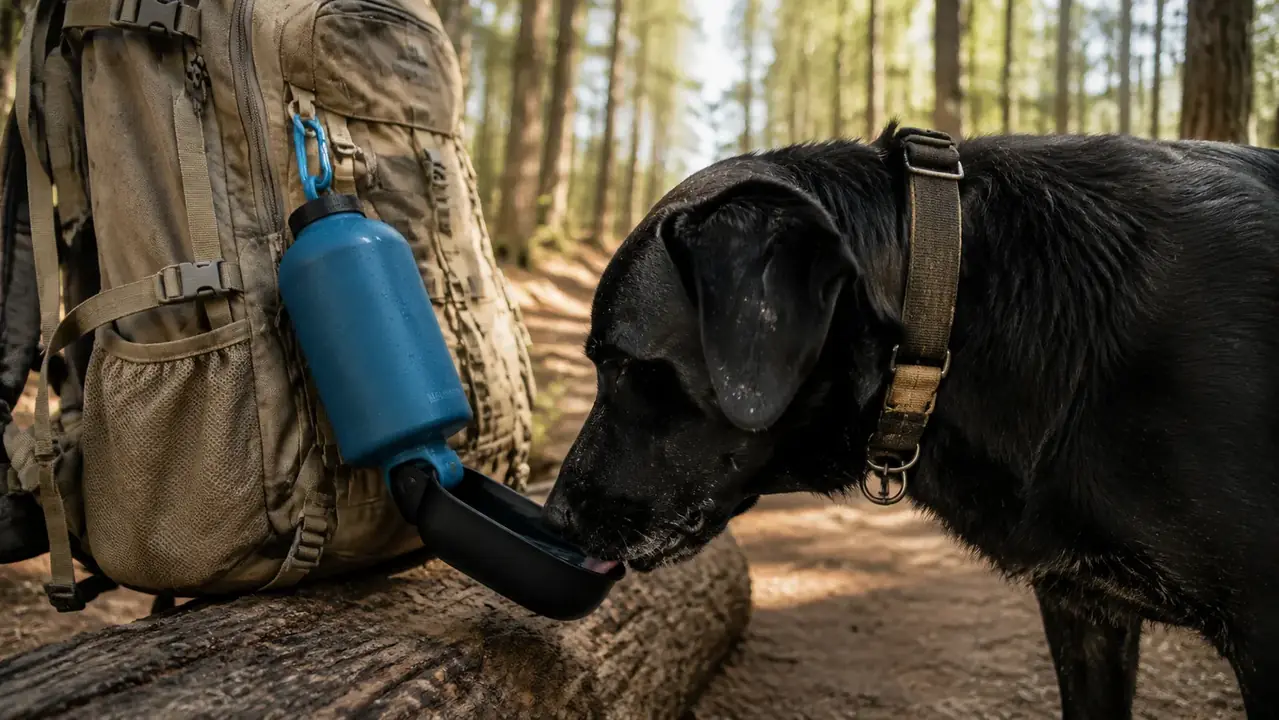
Every dog owner has watched a thirsty dog nose a scummy little pool on the trail and thought somebody should carry a bowl. I did that for years and made do with all the usual stopgaps: a collapsible bowl at the bottom of the pack, a cupped hand over a stream, a shared swig from my own bottle, which the dogs have strong opinions about. None of it worked on a moving dog. Then I picked up the Kalimdor 19-ounce dog water bottle, and for six months now it has clipped to my pack on every trail, fishing trip, and truck stop. It is the reason my dogs drink clean water whether we are ten minutes from the truck or four miles up a ridge.
Duke is my 84-pound black Lab, the retriever that goes everywhere, and Biscuit is the chocolate cross that comes on the milder trips. Biscuit drinks like a fire hose and Duke laps like he is being timed, and between them I have stopped at more puddles, ditches, and questionable stream edges than I can count. The Kalimdor bottle did not reinvent dog water. It just made the boring version easy: your clean water in, a trough that fills with a squeeze, and nothing else to carry. Small, and small is exactly why it still goes on every trip.
The Quick Verdict
For one dog on trails, camp, and truck stops, this is the bottle to start with. Six months of pack rides, gravel drops, and stream rinses later, it has not leaked in the pack and the valve has not failed. The trade is a modest capacity and a trough that wants a rinse once it has been through the dust.
Amazon Check Today's Price →The Kalimdor Bottle That Rides Every Pack
Six months in, this is the one piece of dog kit that has never been left home. If you have watched your dog drink from a puddle one too many times, check today's price on the 19-ounce Kalimdor and see if it earns its spot the way it earned mine.
Amazon Check Today's Price on Amazon →How I've Used It
The bottle works four jobs, and it rotates through them by day. Job one is the trail. The Kalimdor clips to the shoulder strap of my pack and hangs within reach of my left hand, so I do not have to stop and dig. At the first sign of open-mouth breathing on a warm climb, I unclip it, tilt it, and the trough fills while I am still moving. Duke drinks for ten or fifteen seconds and we keep going. On the steeper pitches where he would otherwise flop in the shade and refuse to move, that drink at the switchback buys us the next half mile.
Job two is the truck. A dog that has ridden two hours in summer heat does not want the water break the minute the door opens any less than a person does. I pour the trough at the tailgate before we hit the trailhead, and both dogs get clean water from the same bottle in under a minute. On the way home it does the same job after a long day on the water, when the dogs are wet, dusty, and feeling every mile. It has also become the answer on the errand route, the short runs to the feed store and town where a sticky seat and a wet nose always want a drink.
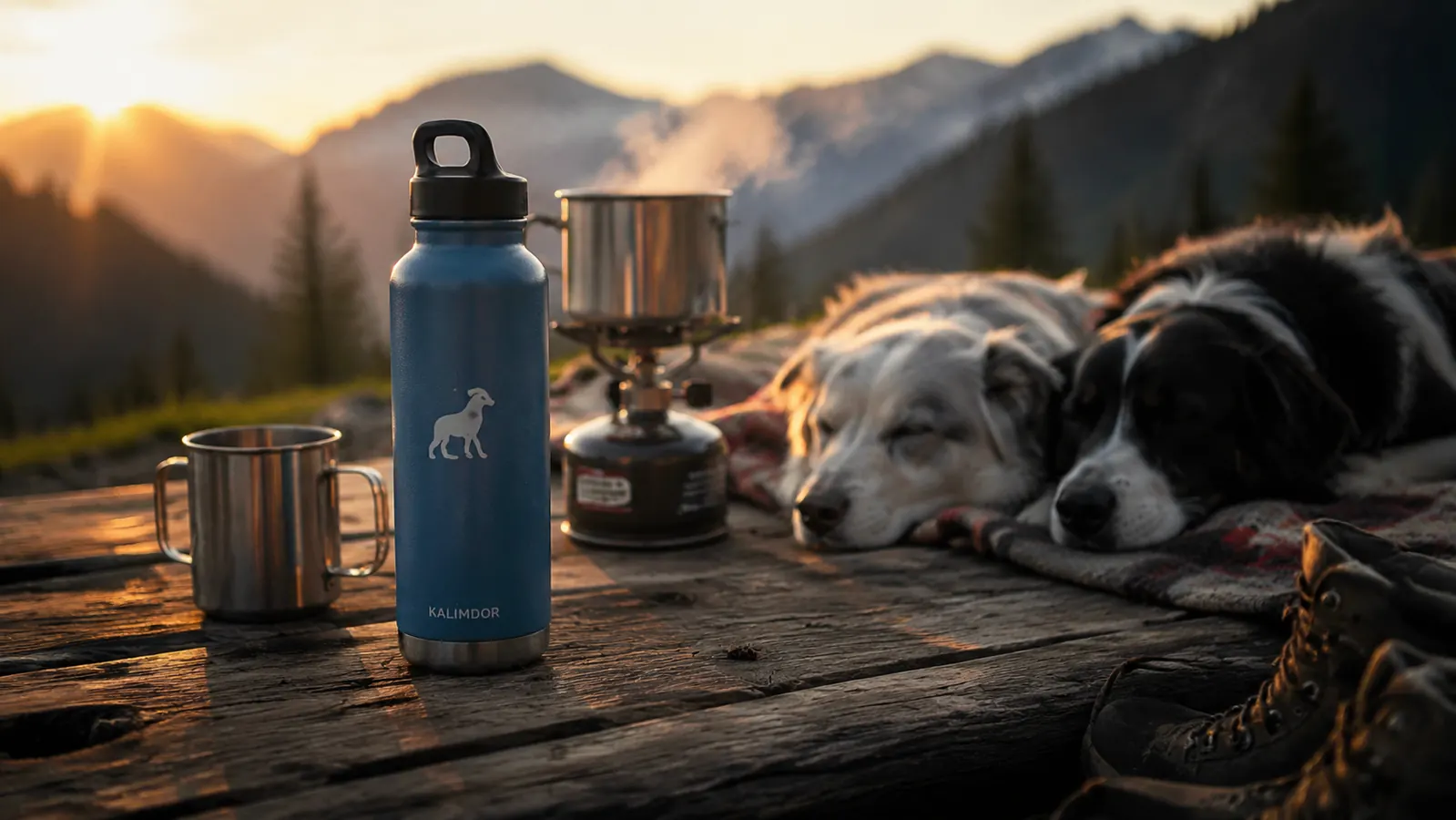
Job three is camp, where the bottle lives on the picnic table next to the coffeepot and keeps the dogs' water near the chairs instead of twenty yards away at the jug. What surprises me is how much use it sees when nobody is on any trail. On a long, slow camp day a restless dog drinks four or five times, and topping the trough without dragging the whole water supply over is a convenience you stop noticing once you have it.
I keep two honest notes about how I have used it. First, I refill it from the truck jug, never from a stream I would not drink myself, because the whole point is to avoid betting your dog's gut on the same water you avoid. Second, I rinse the trough at the end of every trip, not just when it looks bad. Both habits took about a week to become automatic, and both are the reason the bottle still seals and the trough still smells like nothing.
The Design: Bottle and Bowl in One
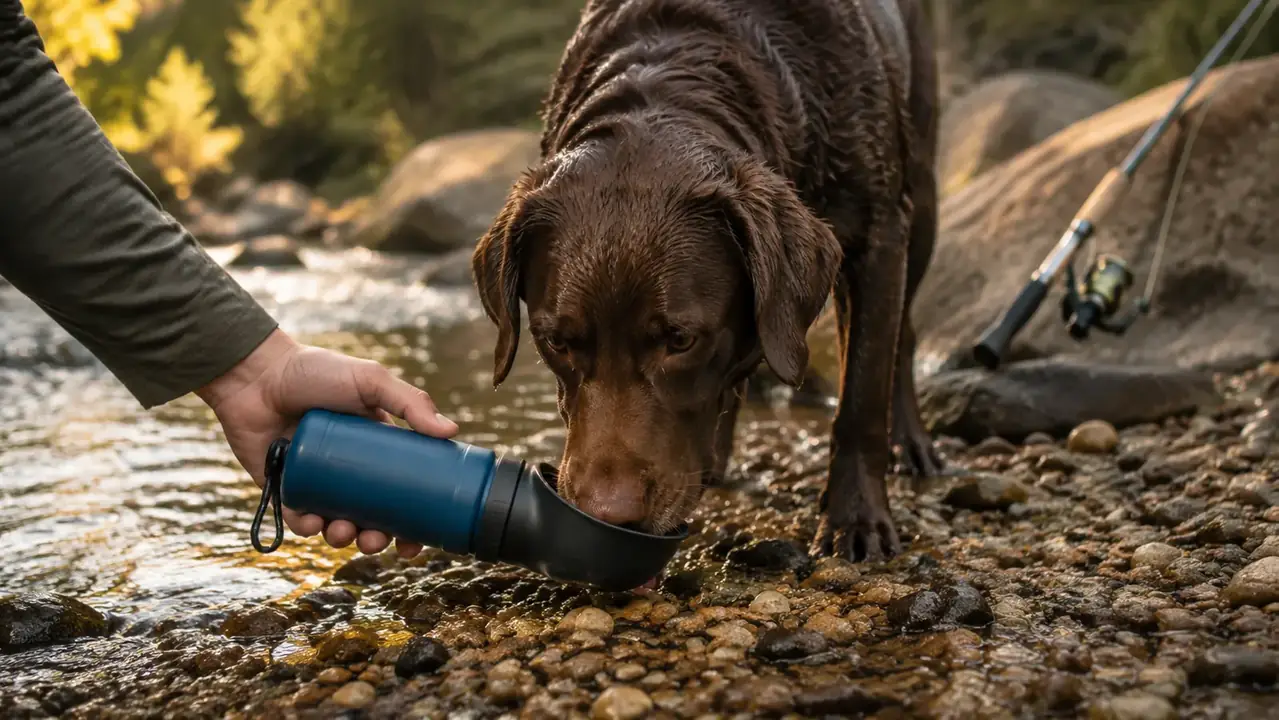
The Kalimdor is not a bowl and it is not a bottle, it is both, and that is the whole point. A trough sits against the base and tips open when you tilt the bottle toward a dog. A press of the valve on the body releases water into the trough, and when the dog is done you tip the bottle back up and the seal closes. One hand works the whole thing, which matters more than it sounds when the other hand is holding a leash, a rod, or a dog that has just spotted a squirrel. With a collapsible bowl you need two hands and a flat, stable spot; with this, you can water a dog on a moving ridge without ever putting down your gear.
The honest number to know is the capacity: 19 ounces, roughly a half liter. That is plenty for a break or two for a mid-size dog and a full session for a small one, and the size is deliberate, since the point is a bottle that rides on a shoulder strap instead of a duffel. For Biscuit it is perfect. Duke on a long summer day wants more than the bottle holds, so I top it up at trailheads and stream crossings. That is the one planning habit the bottle asks for.
The valve has a lock ring, and that is the detail that separates this bottle from the no-name ones. Slide the ring, press, and water flows. Lock it, and the press does nothing. It is one more part that could let me down, and six months in it has not, including a lot of time with grit and pine duff packed around the mechanism. It clicks into place with a sound you come to trust, and after a season I can tell locked from unlocked by feel without looking.
One detail worth calling out because nobody does: when the bottle is closed, the whole thing is a single sealed unit. There is no loose bowl to lose, no lid that pops off at the bottom of a pack, and no floaty piece rattling around. The trough folds flush against the body, so the bottle slips into a hip pocket or a glovebox without snagging on anything. For a piece of gear that spends its life being stuffed and unstuffed, that compact closed shape is half the reason it has not ended up in a drawer.
Six Months In: What Holds Up, What Does Not
Start with the leak test, because that is the claim every bottle makes and the reason most of them end up in a drawer. This one rides in the mesh pocket of my pack on trails, under a rain jacket on wet trips, and wedged against a thermos in the truck. Six months, and the only water that landed where I did not put it was the day I left the cap cracked open, and that was on me, not the seal. The o-ring at the cap still seals tight, and the lock ring has not softened into uselessness the way cheap plastic valves do. I have had budget bottles die in a weekend; this one has not changed its behavior since I bought it.
The clip has been the quiet star. The molded carabiner on the lid has hooked a pack strap, a belt loop, and the rail of a tailgate, and it has held at a dead run. Duke knocked the bottle out of a cupholder onto gravel at a rest stop once, and the body took one small scuff and no crack. The plastic is thick enough that I expected a crack by now, and there is not one.
The trough is the part that collects the most dirt and needs the most care. Dogs drink with their whole face, so the trough comes home gritty, dusty, and occasionally muddy. It rinses out under a tap or in the creek, and once a week I run a bottle brush through it. Leave it dirty for a month and you will wish you had not, because dried slobber has a smell. That is maintenance, not a defect, and I would say it about any bowl you own. A built-in bowl is always going to need wiping down more than a bottle you pour from.
Six months of riding a pack, standing in truck-cab heat, and dropping on gravel, and the only leak I have had came from the day I left the cap open. That was my fault, and I have checked the seal on every trip since.
Where the Bottle Comes Up Short
The honest limit is capacity on a long day with a big dog. Duke's warm-weather session needs more than 19 ounces, so for him the bottle is a clean top-up tool, not a full day of water. On all-day trips I still carry a spare jug in the truck and plan the trailheads. If your dog is a heavy drinker doing real mileage, this is a quality bottle that will simply run out on you, and running out on a hot ridge is the one failure that actually matters.
The water also goes warm. The bottle is not insulated, so on a hot afternoon the water is tepid by the second half of the trail. Dogs do not mind nearly as much as people do, but if cold water matters to you on a 90-degree day, start it chilled or keep it in the shade. And the valve ring, while solid, is molded plastic on a budget bottle. It does not forgive pliers, and you should never need pliers. Neither is a reason to skip it, but they are the details the five-star reviews do not mention, so I am telling you now.
What I Compared It Against
Before I settled on the Kalimdor, I ran three other ways to deliver water. The collapsible bowl was the old method and it still lives in the truck as backup. It holds more, but it is a stop-and-dig chore, it flops over when you set it down, and by week two of a season it smells like whatever puddle it last sat in. It is fine at the tailgate and useless on the move, which is the exact opposite of where I need the help.
I also ran the Cibaabo bottle side by side, the other one you see at every trailhead. That comparison is its own article, but the short version is that the Kalimdor's valve and clip won for my use, mostly because the lock ring and the more compact closed shape ride better on a pack. And there is the simplest route of all, a regular wide-mouth bottle and a careful pour. That works fine at the truck, and I still do it when the Kalimdor is drying out. But it takes both hands and a flat spot, and both dogs treat a wide mouth as a funnel meant for faces. The trough is the part that makes the Kalimdor a trail tool instead of a truck tool.
What I Liked
- No leaks in six months of pack rides, truck cabs, and a gravel drop; the cap seal and lock ring earn their keep
- One hand works the whole thing, which matters on a leash, a climb, or a restless dog
- The trough kills the old stop-dig-pour-bowl chore and gives a dog clean water on the move
- The molded clip rides on a pack strap and has held through a dead run
- More than 8,200 reviews at 4.5 stars, and in six months the rating has matched what I have seen
Where It Falls Short
- 19 ounces is a top-up, not a full day, for a large or heavy-drinking dog
- No insulation, so the water goes tepid on a hot afternoon
- The trough collects dust, grit, and slobber and needs a regular rinse to stay clean
- The valve ring is budget plastic and does not forgive rough handling
- Two thirsty dogs mean a second fill at every trailhead
Who This Is For
Buy this bottle if you trail a dog, fish off gravel bars, camp outside a truck, or run enough errands that a wet dog wants water on the way home. It earns its spot if your trips run a day or less, if you carry a pack anyway, and if you would rather hand your dog clean water than watch it gamble on a puddle. If your dog is a single mid-size or smaller animal, this may be the only water system you need, and that is a genuinely light thing to carry. If you are still working out how much to carry and when your dog needs it, my practical guide to keeping a dog hydrated on the trail covers the math that makes the bottle work.
It is also the right call for the weekender who is tired of the three-piece kit, the bowl plus the bottle plus something to clip it all to. The Kalimdor collapses that down to one object that rides on the pack. If you have watched your dog hesitate at a puddle and then drink it anyway out of thirst, that is the person this bottle is aimed at. That was me, and it is the reason I stopped guessing.
Who Should Skip It
Skip it if your dog drinks a liter or more every time the pack comes out, because on a long summer day you will be refilling constantly and a bigger vessel with a collapsible bowl will serve you better. Skip it if ice-cold water matters to you on hot trails, because the bottle is not insulated and that matters more to some people than to the dog. And skip it honestly if you will not rinse the trough, because a dirty trough is nobody's idea of clean water and no bottle fixes a habit you will not keep.
For everyone else, that is the honest ledger after a full season. The Kalimdor is not perfect gear and I would not insult you by pretending otherwise: the capacity is a short leash on a long day, the water warms, and the trough asks for a rinse. What it is, is the most dependable dog-water rig I have owned, the one that has never leaked in the pack and never once left a dog dry on a hot trail. For water, that is the whole job.
Give Your Dog Clean Water on Every Trip
Six months on, the Kalimdor is the one bottle that still clips on for every outing. If a puddle-drinking dog is one trip from a vet bill, check today's price on the 19-ounce. And if you are still weighing it against the Cibaabo, my side-by-side comparison lays out the difference.
Amazon Check Today's Price on Amazon →