
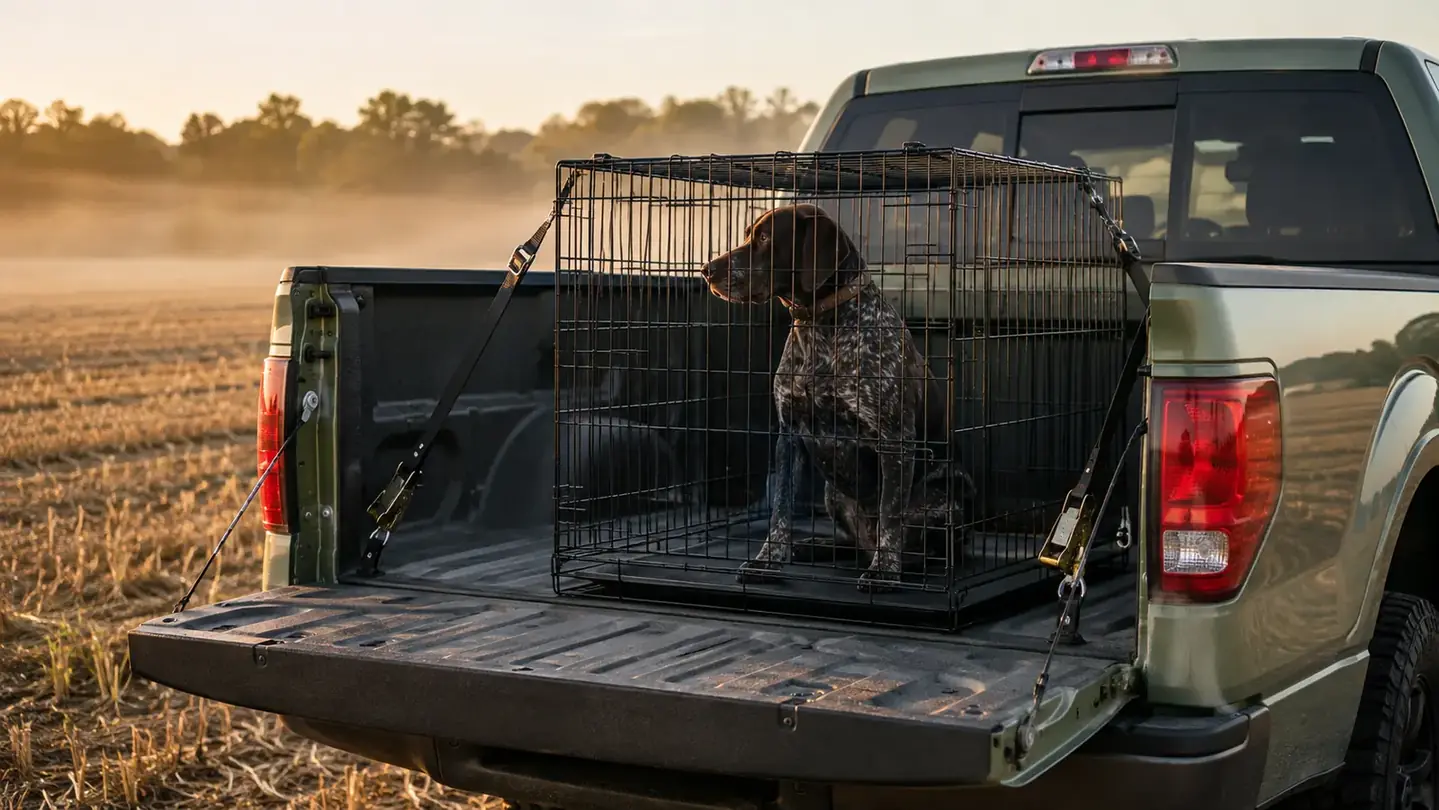
You only have to watch a loose hunting dog ride a truck bed once to understand why the crate earns its spot before the gun cases do. First time I hauled Sadie, my German Shorthaired Pointer, without the crate, she spent every mile braced against the cab window, panting, and rewound herself on the leash every time I touched the brakes. She was not hurt. She was not happy either, and a dog that is not happy before the sun comes up is not a dog you want holding a point at nine.
The answer was not more obedience sessions, it was a place that belonged to her. I crate trained Sadie for the truck in five steps over about three weeks, moving the same 42-inch wire crate from a corner of the kitchen to the back of the Tacoma, and now she checks for it before she checks for the shotgun case. Here is exactly how we did it, the mistakes I watched other hunters make the same season, and where the whole plan can go wrong.
Start With a Crate That Fits the Dog and the Truck on Day One
We trained in the Midwest 42-inch iCrate, the folding single-door model. It collapses flat for storage, sets up without tools, and the single door faces the tailgate in a standard five-foot bed. For a dog in the 71 to 90 pound range it is the first crate I would hand a friend.
Amazon Check Today's Price on Amazon →Why the Crate Instead of a Loose Dog
The reason this matters is not tidiness. A loose dog in a truck bed has nothing to brace against, so every hard stop turns 60-plus pounds of dog into a body slamming the tailgate or the cab wall. I know one hunter who watched his yellow lab go over the side on an off-camber gravel road. The dog came out fine, but everyone who saw it went home and ordered a crate that weekend. A properly sized crate gives the dog a wall on all six sides and a floor they already know.
There is a quieter reason too. Hunting dogs run hot all day and their off switch is weak. A crate is not punishment, it is the only place a wired dog gets told it is okay to sleep. Sadie was a different dog on the ride home the first week she was crated. No pacing, no whining at the window, just her head down on the pan until we hit the truck stop. That one behavior change is the whole payoff.
Step 1: Size the Crate to the Dog, Not to the Truck
Crate sizing is where the plan succeeds or dies, and it is the step almost everyone gets wrong. The rule I use: with the dog standing, the crate needs to be long enough for the dog to lie flat with the nose short of the back wall, and tall enough to stand without the ears touching the top. Measure from the base of the tail to the front of the chest and add four to six inches. That is the length you shop for, nothing else.
Sadie runs about 66 pounds, and the 42-inch Midwest iCrate fits her with room to sprawl out in the summer. The rating on the box is for dogs from 71 to 90 pounds, and that range is honest for deeper-chested dogs and big labs. The same brand makes 30 and 36 inch sizes for spaniels and setters. A dog that soils the crate because the crate is oversized is not a training failure, it is a sizing failure, so buy to the dog rather than to the sale.
One more thing worth knowing before you spend: the Midwest ships with a divider panel that shrinks the usable floor, which matters if you are starting with a pup. The old rule about puppies is that a crate too large teaches them to sleep at one end and go at the other. The divider handles that, and it is a few dollars of peace of mind that the cheapest wire crates do not include.
Step 2: Make the Crate the Place Where Food Happens
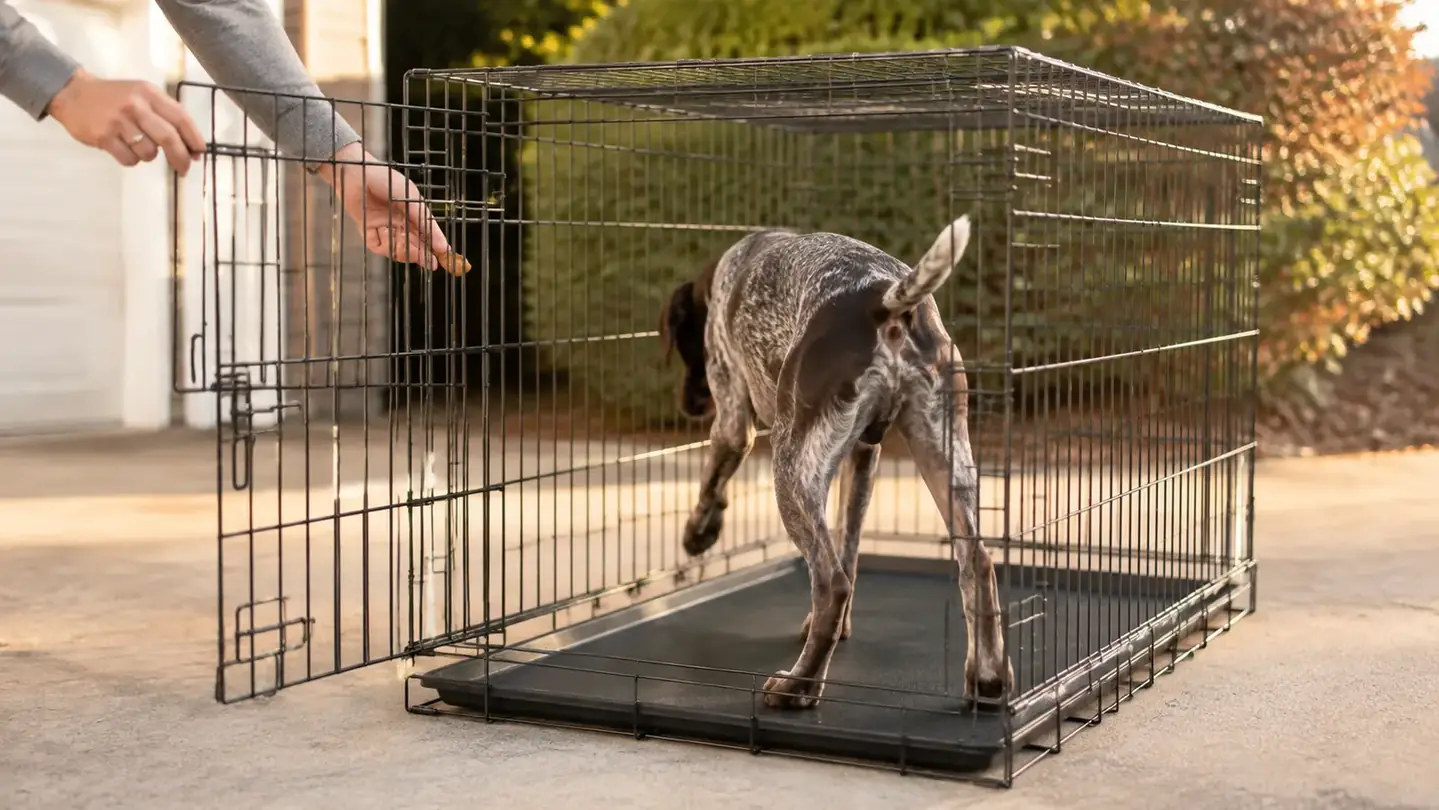
For the first week the crate lived inside, in the corner of the kitchen, with the door wedged open. No truck, no closed door, no pressure at all. The only rule was that meals happened inside it, plus the occasional treat or chew tossed toward the back. Sadie started backing in for breakfast on her own by day three. That is the whole step, and it is more than half of the battle.
Do not skip this step to save time. The crate is competing against the entire yard for your dog's attention, and food is the one thing that wins. If every single meal happens inside the crate for the first week, the wire box stops being something you bought and becomes the thing dinner comes from. My partner ran the same drill with our camp dog Riggs, and it took him four days to make the same connection. The dogs announce it themselves, you just have to feed in there until they do.
Step 3: Teach One Word, Then Close the Door
We used the cue 'kennel.' One word, said once, with a treat tossed to the back corner. Say it before the throw every time, let the dog chase the treat, praise once they are inside. After a few days you can say the word and skip the throw. The dog steps in because the word now means the treat used to follow. Keep it to one syllable so it cuts through wind noise at a gravel pit.
The door is the part that needs patience. In week one I closed the door for two minutes, opened it, and let her out on her own. I never pulled her out. If she fussed, I waited her out until she settled and only then opened. Then I stretched sessions to ten minutes while I sat in the next room, then twenty. The goal is for the dog to find the closing door boring rather than scary, long before the truck ever moves.
Step 4: Move It to the Truck and Set the Bed Rules
Before you drive anywhere, get the dog comfortable being crated in a parked truck. Load up in the driveway, shut the tailgate, sit in the cab with the engine off for fifteen minutes, and if the dog stays quiet, open everything up and make a fuss. You are teaching that getting in the truck does not mean the trip starts the second they load. The driveway drill is what makes the first real haul calm instead of frantic.
The crate rides strapped down. The Midwest folds flat and stands up in seconds, and the single door facing the tailgate is the right orientation because the dog backs in and faces the cab, toward the motion. Four ratchet straps over the top corners stop the folding frame from rattling, which it will do on washboard roads otherwise. A crate that slides around the bed is worse than a tie-out, because it can shift on a corner and pin the dog.
The bed rules are non-negotiable. The door latches every single time, the dog does not ride loose on the way to a hunt, and the crate comes out for a hose when the dog climbs in wet and muddy. The plastic pan is why this works. Twenty seconds with the hose and the bed stays clean enough to haul gear home in.
Sadie slept through a rifle shot set two hundred yards from camp the same month she started riding in the crate. That sounds small until you have hauled a dog that spends every gunshot screaming under the seat.
Step 5: Run the Same Drill at Camp Until It Is Routine
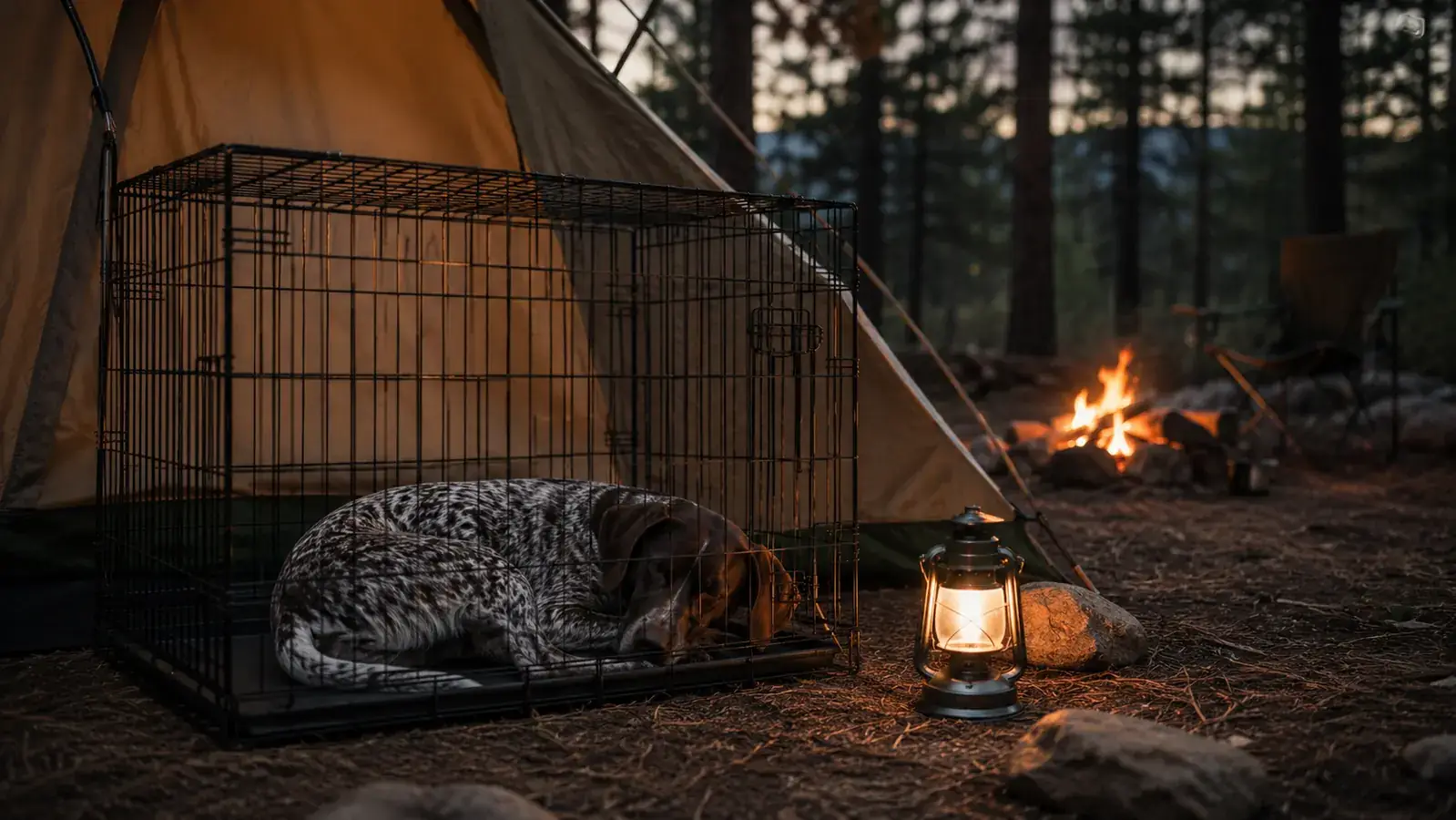
Camp is where the training pays for itself, and the reason is repetition. At home the crate sits in the kitchen corner. At camp it sits by the tent. Same crate, same cue, same meals inside it, and the dog starts treating both like the same place. By the second campout Sadie was curling up for the night the way she does at home, and Riggs was following her in. The dog who goes first always decides how the night goes at camp, so get the one who is already sold on the crate to lead.
The release matters here too. We do not open the door and let the dog flood out the instant the gun case unzips. The dog waits for the word, and that one small pause is what keeps a scent-crazy bird dog from parking on the crate door all evening. When the work is over they load back in the same way, dry or muddy, and that sameness is the entire trick.
What Else Helps
Two things that are not steps but made the whole plan hold up. First, parking strategy in warm months: a wire crate in the sun is an oven, so we park in the shade or drape an old tarp over the top half while we work a field, and we never leave a dog closed in a crate that is cooking. Second, keep a spare pan. The Midwest pan hoses off in seconds, and having a second one means a wet morning of hunting does not turn into a soaked truck seat on the drive home.
If you are crating on the road for the first time, start with short runs to the gas station before you tackle a four-hour haul to a hunt unit. The dog will tell you whether the plan is working. A quiet dog at mile thirty is a dog that will make the whole season easier, and that is the only metric that matters.
None of this took extraordinary patience, and I watched two dogs this same season go from door-shy to self-loading in under a month. Start with a crate that fits, feed in it, teach one word, strap it down in the truck, then run the same routine at camp. By deer season the crate is not something you drag to the truck, it is where the dog waits for you.
One more thing worth repeating: the crate is only half the job, the restraint habit is the other half. A dog that rides loose in the cab is a missile at any speed, and a 60-pound dog hitting the dash in a hard stop can hurt you both. Wherever you land on the crate question, make the decision on the driveway, not on the highway, and make it once. The truck is no place to be working through a dog's opinion of containment.
The Crate We Trained In Is Still the One We Would Buy Again
The Midwest iCrate 42-inch single door includes the divider panel, folds flat for storage, and has carried a season of wet, muddy bird dogs without complaint. If your dog is in the 71 to 90 pound range, check today's price before the season gets going.
Amazon Check Today's Price on Amazon →